Arno Wouters
philosophy of biology / philosophy of action / biology of cognition
Current job
From 1 September 2019 to 30 November 2019, I work, on Thursdays, at the Faculty of Arts of Groningen University. I teach the Biology of Cognition course in the Minor Culture and Cognition.
Recent jobs
From 1 September 2018 to 30 November 2018, I worked part-time at the Faculty of Arts of Groningen University. I taught the Biology of Cognition course in the Minor Culture and Cognition.
From 30 January 2017 to 31 July 2017, I worked part-time as adjunct professor at the Department of Philosophy of Leiden University. I taught a course in moral psychology ('The Moral Brain') in the Ethics, Politics and Culture minor.
A short CV
- I studied biology at Wageningen University (1974-1980).
- I studied philosophy at Groningen University (1980-1986).
- I obtained a PhD in philosophy of science from Utrecht University (1999).
- I did research in philosophy of science at Utrecht University (1989-1994).
- I taught a variety of courses in theoretical philosophy at several universities (Groningen, Utrecht, Nijmegen) (1995-1997).
- I worked 3 years as a researcher in computer science (1998-2000).
- I worked 2 years as lecturer philosophy of the life sciences at the Institute Biology Leiden (2001-2002).
- I worked 10 months as a staff member for the Centre for Society and Genomics (2004).
- I worked 2 years as postdoc Neuroscience and Personhood at the Heyendaal Institute Nijmegen (2005-2007).
- I taught philosophy of biology at the Institute for History and Foundations of Science (Utrecht) (2007, 2008, 2009).
- I taught philosophy of mind and action at the Radboud University Nijmegen (2007-2008).
- I taught philosophy of cognitive science at Utrecht University (2008).
- I worked 4 years as postdoc philosophy of action at the Erasmus University Rotterdam (2009-2012)
An elaborate CV can be found here.
Personal info
I live in Utrecht, The Netherlands.
Philosophy
My philosophical research interests include:
- philosophy of action in connection with psychology, neuroscience and evolutionary biology,
- explanation and understanding in biology, cognitive science and psychology,
- philosophical aspects of systems biology,
- mechanisms, causality, counterfactuals, laws of nature,
- the relation between different levels of organization (reduction, emergence, supervenience, constitution),
- teleology and structuralism, Darwin, D'Arcy Thompson, 19th and 20th century morphology, history of evolutionary biology,
- gene centrism and genetic determinism.
|
|
Interests and hobbies
My interests include: computers, nature, natural science (especially biology), and philosophy.
My favorite pastimes are: reading, hiking, bird watching, dancing, and the internet.
E-mail
My private e-mail address is: 
Please, consult me in advance if you want to send me attachments.
|
|
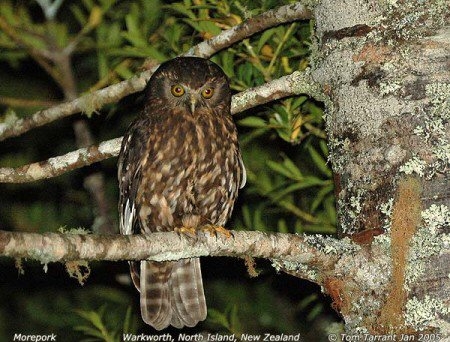
The name of this site is derived from New Zealand's only surviving native owl, the Morepork or Ruru.
I had a great time tramping in New Zealand and an owl seems an appropriate symbol for a philosopher of biology
(picture courtesy of Tom Tarrant from aviceda).
|
Past talks
Selected contributions to the web
Philosophy
- Zwervende gedachten, mijn blog over argumentatie, biologie, handelingstheorie en wat me verder invalt (my blog on argumentation, biology, action theory and whatever else comes to my mind, in Dutch).
- Links to discussions in which I participated
- Comments on Dan Grauer's ideas of functions (May 2014)
- Van Rossum's Rode Haring - My criticism of Joris van Rossum's dissertation "On Sexual Reproduction as a New Critique of the Theory of Natural Selection" (Evolutie blog, 20 februari 2013, in Dutch)
Internet, software, computers etc.
Nature
Selected publications
A more complete list of publications is here.
BCN-science and responsibility (neuroethics)
- Arno Wouters "Neurowetenschap en mensbeeld" (lezing gehouden voor het symposium De (ir)relevantie van de neurowetenschap voor sociale wetenschappen, filosofie en religiewetenschappen, Heyendaal Institute Nijmegen, 4 October 2005 (in Dutch).
- Arno G. Wouters "Ontoerekeningsvatbaarheid: een achterhaalde notie?" Neuropraxis 10(5): 136-139 (2006). The manuscript is available from my website.
- Arno G. Wouters "Woont de persoon tussen de neuronen?" Filosofie, jrg. 17, nr. 4 (themanummer "De geest als natuurverschijnsel"), pp. 22-25.
- Maureen Sie & Arno Wouters "The real challenge to free will and responsibility" Trends in Cognitive Science 12(1): 3-4 (2008). (A final draft is available from my website.)
- Maureen Sie & Arno Wouters "The BCN-challenge to compatibilist free will and personal responsibility" Neuroethics 3(2): 121-133.
- Arno Wouters "Vrije wil en verantwoordelijkheid in evolutionair perspectief". In: Maureen Sie (red.) Hoezo vrije wil? Perspectieven op een heikele kwestie (Uitgeverij Lemniscaat, 2011), hoofdstuk 10, pp. 190-209.
- Maureen Sie & Arno Wouters "Gedraag je! Over Auto's, Aansturing en Verantwoordelijkheid" Filosofie 21(3) 21-27 (aflevering 121, mei/juni 2011).
Explanation in biology (philosophy of science)
- Wouters, Arno G. (1995) "Viability Explanation" Biology & Philosophy 10: 435-457.
- Wouters, Arno G. (1999) Explanation Without A Cause. Ph.D. thesis, Utrecht University.
- Wouters, Arno G. (2003) "Four Notions of Biological Function" Studies in History and Philosophy of Biology and Biomedical Science 34(4): 633-668.
- Wouters, Arno G. "The Functional Perspective of Organismal Biology". In: T.A.C. Reydon and L. Hemerik (eds.), Current Themes in Theoretical Biology: A Dutch Perspective (Springer, Dordrecht, 2005), p. 33-69.
- Wouters, Arno G. (2005a) "The Function Debate in Philosophy" Acta Biotheoretica 53(2): 123-151.
- Wouters, Arno G. (2005b) "Functional explanation in biology". In: R. Festa, A. Aliseda, and J. Peijnenburg, Cognitive Structures in Scientific Inquiry: Essays In Debate With Theo Kuipers vol. 2 (Poznan Studies in the Philosophy of the Sciences and the Humanities 84), p. 269-293, Rodopi, Amsterdam & Atlanta (Ga.).
- Wouters, Arno G. (2007) "Design Explanation: determining the constraints on what can be alive" Erkenntnis 67(1): 65-80. (A final draft is available at my website, the original publication is at www.springerlink.com).
- Essays on Explanation in biology, Biological function, and Functional explanation (August 2010). To be published in Werner Dubitzky, Olaf Wolkenhauer, Kwang-Hyun Cho, Hiroki Yokota (Eds.) Encyclopedia of Systems Biology (Springer, 2012).
- Wouters, Arno G. (2013) Biology's Functional Perspective: Roles, Advantages and Organization. Chapter 21 of Kostas Kampourakis (ed.) The Philosophy of Biology Springer 2013.
Computer science
Recommended information and links
Especially for philosophy students, but many others may profit from it.
Computers and internet
- Top 10 Simple Things Every Computer User Should Know How to Do
- How to Back Up Your Computer to an External Drive
- Basic concepts of Microsoft Word (Shauna Kelly). Do not use MS Word if you do not have the time, energy and patience to understand and tame it. It takes several days to understand Word -- it costs you years, your face and your health, if you use it without understanding it. If you know already how to type in a word processor, start with concept 3: use styles to format text and read on -- you will always have problems with Word if you do not use styles consciously and consistently!
- Stop AutoFormat and its Evil Cousins (Daiya Mitchell). You will never be happy with MS Word if you do not disable all the irritating features Microsoft put there to impress first-time users. Don't hesitate. Do it. NOW!
- Bend Word to Your Will (Clive Huggan). The ultimate guide to using Word. Especially written for the Mac -- Windows users will equally profit, if they make a few mental adjustments when reading (the guide provides tips for making these adjustments).
- MS-Word is Not a document exchange format (Jeff Goldberg) -- "MS-Word is appropriate for document exchange among co-authors of a document who are all developing it and have agreed before hand to use MS-Word". Don't exchange Word documents in any other case!
- PDF Online converts Word Documents and many other formats to PDF for free. No need to send anyone Word documents anymore.
Philosophy
 This page was made by Arno Wouters.
E-mail: 
Last Updated: 31 Aug 2019.